

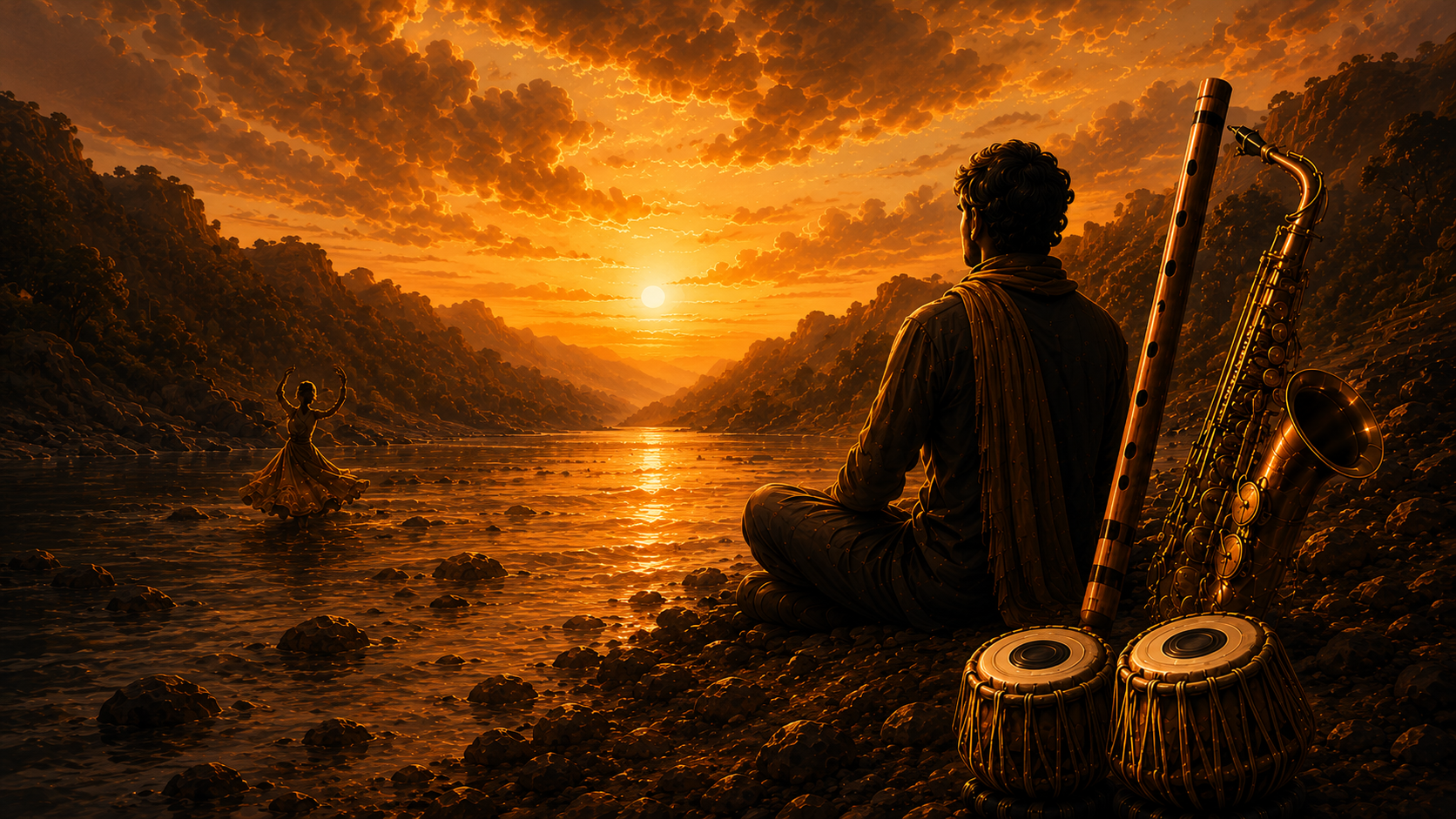
WHAT THE RIVER REMEMBERS
A new orchestral work for orchestra, the Temporal Taal Collective, and Kathak dance.
Every River Carries a Memory.
Some memories belong to us.
Others belong to generations before us.
In 2024, composer and saxophonist Anjan Shah traveled to the banks of India's sacred Narmada River to immerse the ashes of his father. Standing beside waters that have witnessed thousands of years of human history, he realized the river was carrying more than a single farewell.
It was carrying memory itself.
From that moment emerged What the River Remembers—a new orchestral work that explores inheritance, migration, identity, loss, and renewal through a musical language where Hindustani tradition, jazz improvisation, and Western symphonic writing become one voice.
Not traditions in conversation.
One story.
A Story Told Through Music, Movement, and Memory
Approximately twenty-two minutes in length, What the River Remembers is written for full orchestra, the Temporal Taal Collective, Kathak dancer, and chamber choir.
Inspired by a deeply personal journey, the work speaks to something universal:
How do we carry the people who shaped us?
What do we inherit?
What continues long after we are gone?
Rather than presenting different musical cultures side by side, the composition treats them as a single artistic language shaped by lived experience.
The river does not separate worlds.
It connects them.
The Ensemble
Temporal Taal Collective
Tenor Saxophone
Bansuri
Tabla
Guitar
Bass
Drum Set
Kathak Dance
Chamber Choir
with Full Symphony Orchestra
3.2.3.2 – 4.3.3.1 – Timpani + 2 Percussion – Strings
The orchestral palette draws inspiration from Debussy and Ravel's transparency, the emotional breadth of symphonic jazz, and the rhythmic architecture of Indian classical music.
The result is neither fusion nor crossover.
It is a fully integrated contemporary orchestral language.
Kathak as Narrative
Kathak is not added to the work.
It is woven into its architecture.
The dancer becomes another storyteller, entering into rhythmic dialogue with the tabla, orchestra, and improvising soloists. Gesture, footwork, silence, and movement become musical material themselves, creating an experience where choreography and composition are inseparable.
Lighting and staging further immerse audiences, transforming the concert hall into a space where music, movement, and memory unfold together.
The Four Movements
I • Before the Water Spoke
Breath before language.
A solitary bansuri emerges from suspended orchestral textures as fragments of memory slowly surface.
II • Currents Beneath the Surface
Rhythms awaken.
Jazz harmony, Indian rhythmic cycles, and orchestral development begin to intertwine, reflecting the complexity of belonging to more than one world.
III • Fire Carried by the Water
The emotional and rhythmic heart of the work.
Kathak, tabla, orchestra, and improvisation collide in an exhilarating celebration of movement, rhythm, and transformation.
IV • Where the Light Returns
Earlier themes return transformed.
Tenor saxophone and bansuri rise above luminous orchestral textures as the work arrives not at resolution, but acceptance.
The river continues.
So do we.
Why This Work Matters
Today's orchestras are searching for programming that expands artistic possibility while creating meaningful connections with increasingly diverse communities.
What the River Remembers offers something deeper than cross-cultural collaboration.
It is an original orchestral work born from authentic lived experience—one that invites audiences into a shared story of family, memory, identity, and belonging.
Accessible without sacrificing sophistication.
Emotionally immediate while compositionally ambitious.
Personal in origin.
Universal in meaning.